The Leave a Mark OKR Manual, Part 1, Article 2
Most companies that try OKRs quietly stop within a year. “OKRs are not working” is what I often hear. What I have learned over the years is the tool is almost never the problem.
At Leave a Mark we get called in after the first attempt, not before it. So we've seen the same deaths over and over: the spreadsheet nobody opened after week four, the quarterly review that turned into a status meeting, the "objectives" that read like a mission statement wrote them. None of these companies were stupid. They just walked into a failure mode they couldn't see from the inside.
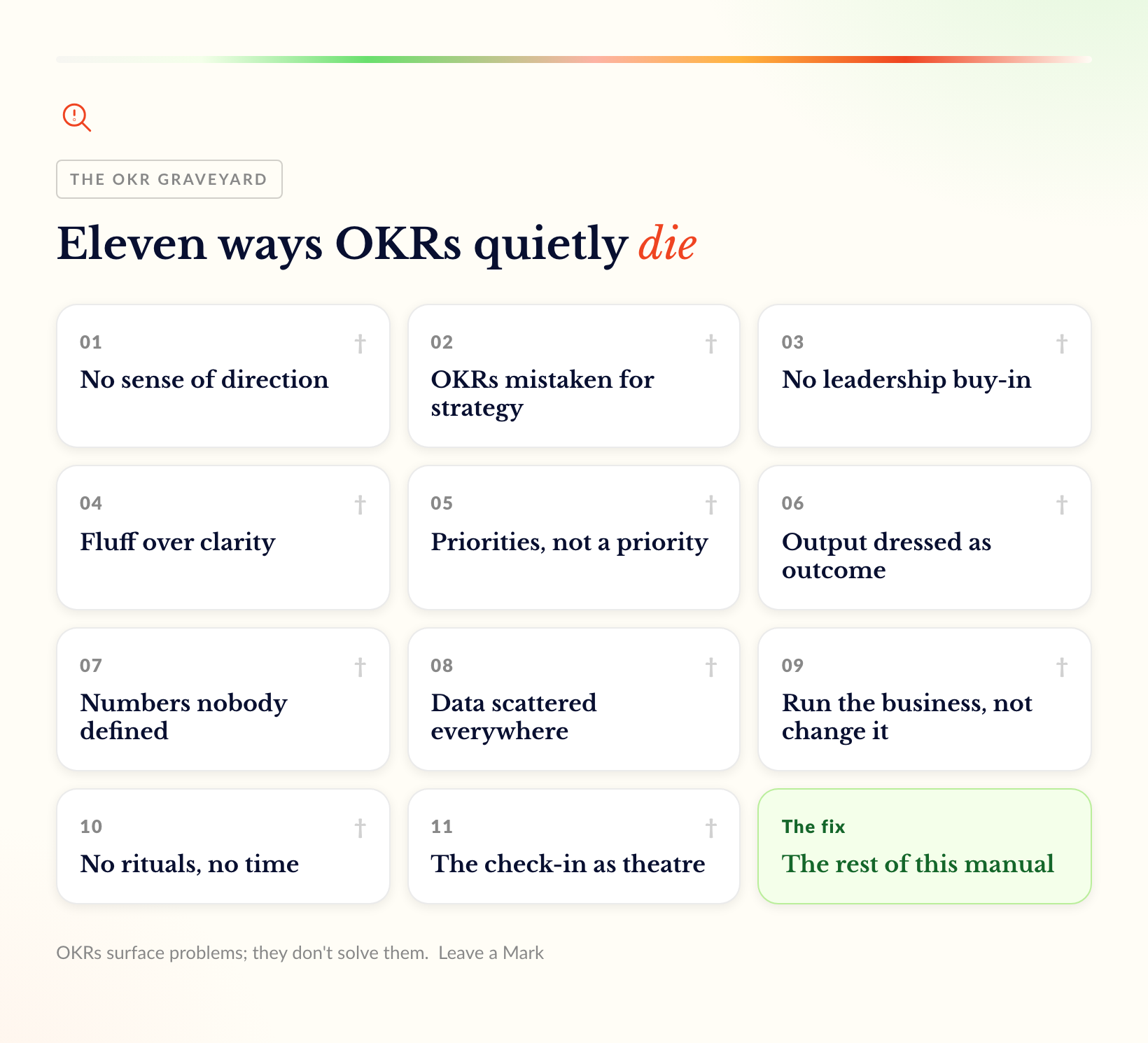
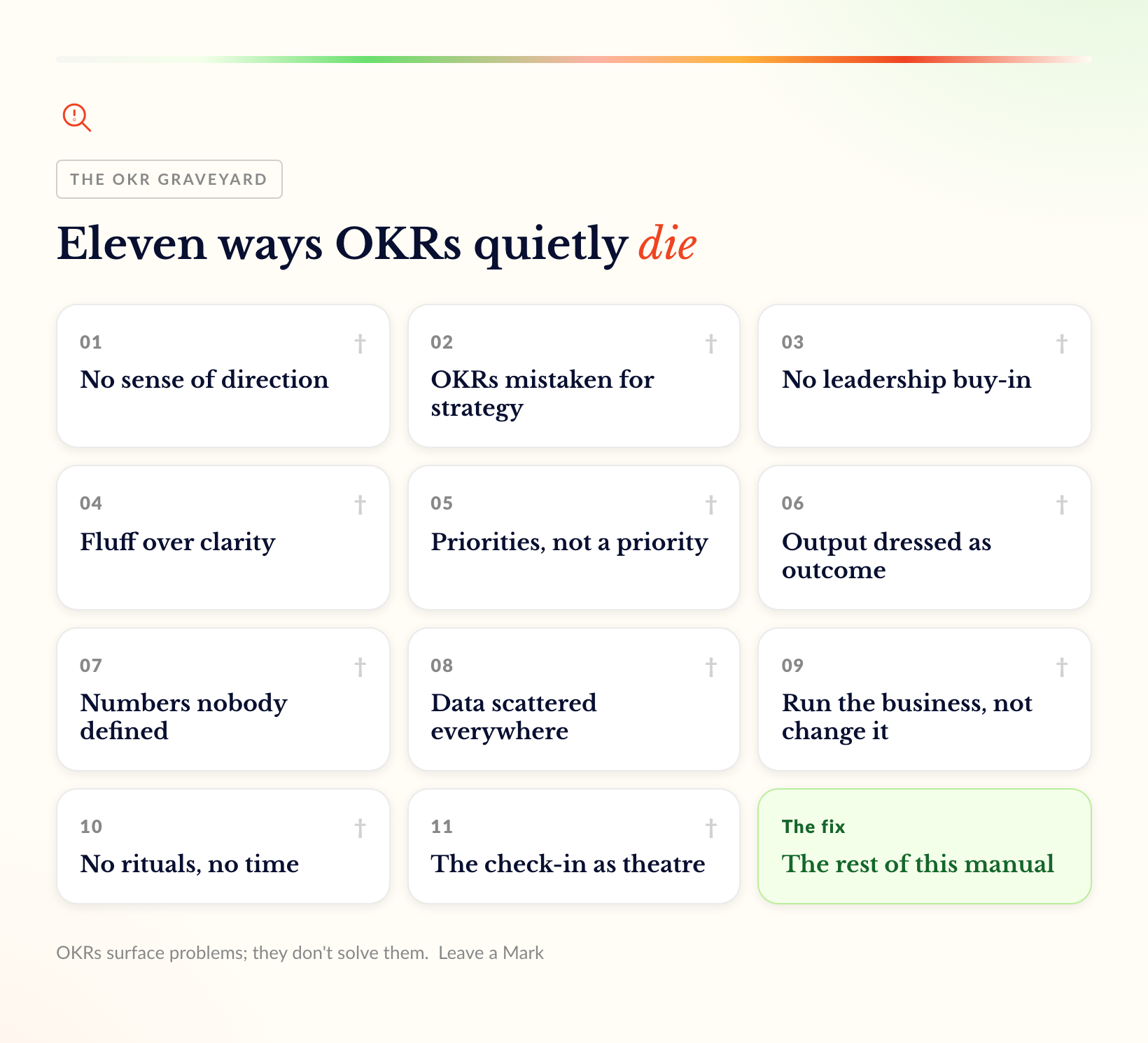
So here is the graveyard. Eleven headstones, each with the story of how OKRs died there, and the lesson that keeps you off the same plot. These are the failure modes we see most. The rest of this manual exists to fix them.
1. You're not sure where you're going
A case we saw: A 70-person software house rolls out OKRs because a board member read a book. Three weeks in, one team's objective is "grow the business", another's is "improve quality", and nobody can say which one wins when they collide. The arguments start. They were always going to.
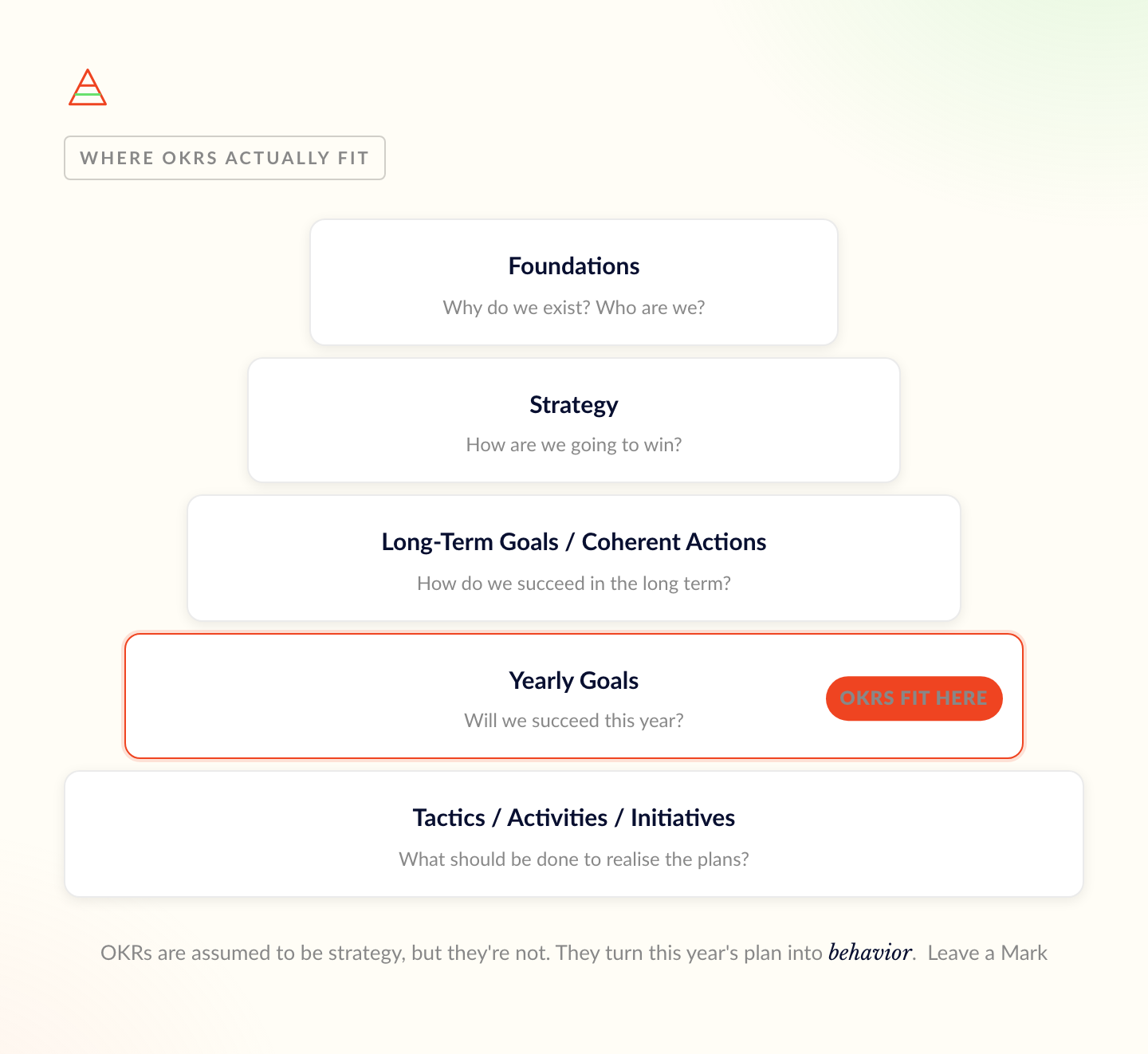
OKRs are a focusing tool, not a direction-finding one. If there's no mission, no vision, no agreed sense of where the company is heading, OKRs don't fill that gap. They expose it. Suddenly every team is forced to derive priorities from a strategy that was never written down, and they derive different ones. The fix isn't better OKRs. It's doing the foundations work first, then letting OKRs turn that direction into behavior.
2. You forgot OKRs are one tool inside a bigger framework
A case we saw: A Series B SaaS company treats its OKRs as the strategy. Ask the CEO "how do we win?" and the answer is a list of key results. A year later they've hit most of the numbers and lost ground to a competitor who picked a sharper fight.
OKRs sit near the bottom of the stack, at the layer where this year's plans become daily work. They assume a strategy already exists above them. Richard Rumelt's kernel of good strategy is a diagnosis, a guiding policy, and coherent actions. OKRs are how the coherent actions get executed, not how the policy gets chosen. Strategic planning is not strategy. If you skip the choice of where to play and how to win, no amount of clean key results will save you.
3. Leadership isn't actually bought in
A case we saw: The COO champions OKRs. The CEO nods in the kickoff, then skips the next four check-ins because "something came up". By quarter's end the whole company has learned that this is optional. It dies from the top, silently.
The fish rots from the head. OKRs demand that leaders make hard choices in public, say no to good ideas, and show their own numbers going red. If the person at the top won't do that, everyone below them notices and quietly opts out. You need at least the CEO genuinely committed, not politely supportive. Real buy-in looks like the leader changing their own behavior first, not delegating the change downward.
4. You over-complicate everything into fluff
A case we saw: "Objective: Drive sustainable value creation across the customer lifecycle through operational excellence." A whole leadership team spent an afternoon on that sentence. Nobody in the company could tell you what to do differently on Monday because of it.
Complexity is the enemy of execution. When an objective tries to say everything, it says nothing, and the team can't act on it. The test is simple: can someone read the objective once and know, roughly, what changes? If it takes a second read, it's fluff. Clarity beats sophistication every time. Write it like you'd say it to a colleague in the hallway, not like you'd put it in an annual report.
5. You set priorities, plural, instead of a priority
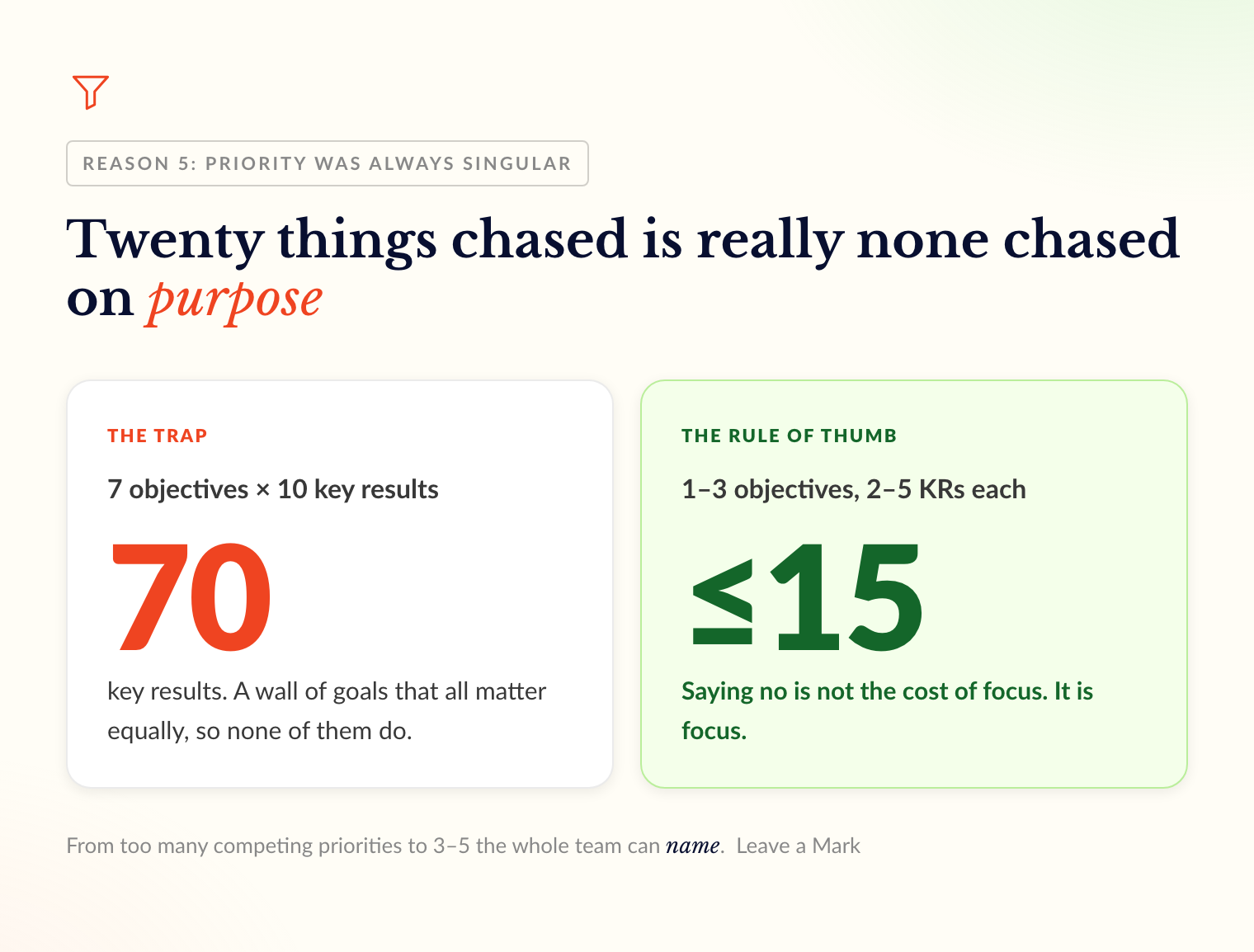
A case we saw: A 120-person company sets seven objectives, each with ten key results. Seventy key results. The team looks at the wall of goals, feels the specific dread of everything mattering equally, and goes back to doing whatever was already on fire.
The word "priority" was singular for five hundred years before we pluralised it. Focus is the whole point. Our rule of thumb is 1 to 3 objectives per cycle, 2 to 5 key results each. Not because more is impossible, but because more is a lie: a team that is chasing twenty things is really chasing none of them on purpose. Saying no is not the cost of focus. It is focus. This is the move from too many competing priorities to 3 to 5 priorities the whole team can name.
6. You treat output as outcome
A case we saw: An engineering team's key result is "ship the new onboarding flow". They ship it, on time, and grade themselves green. Activation doesn't move. They hit the target and missed the point.
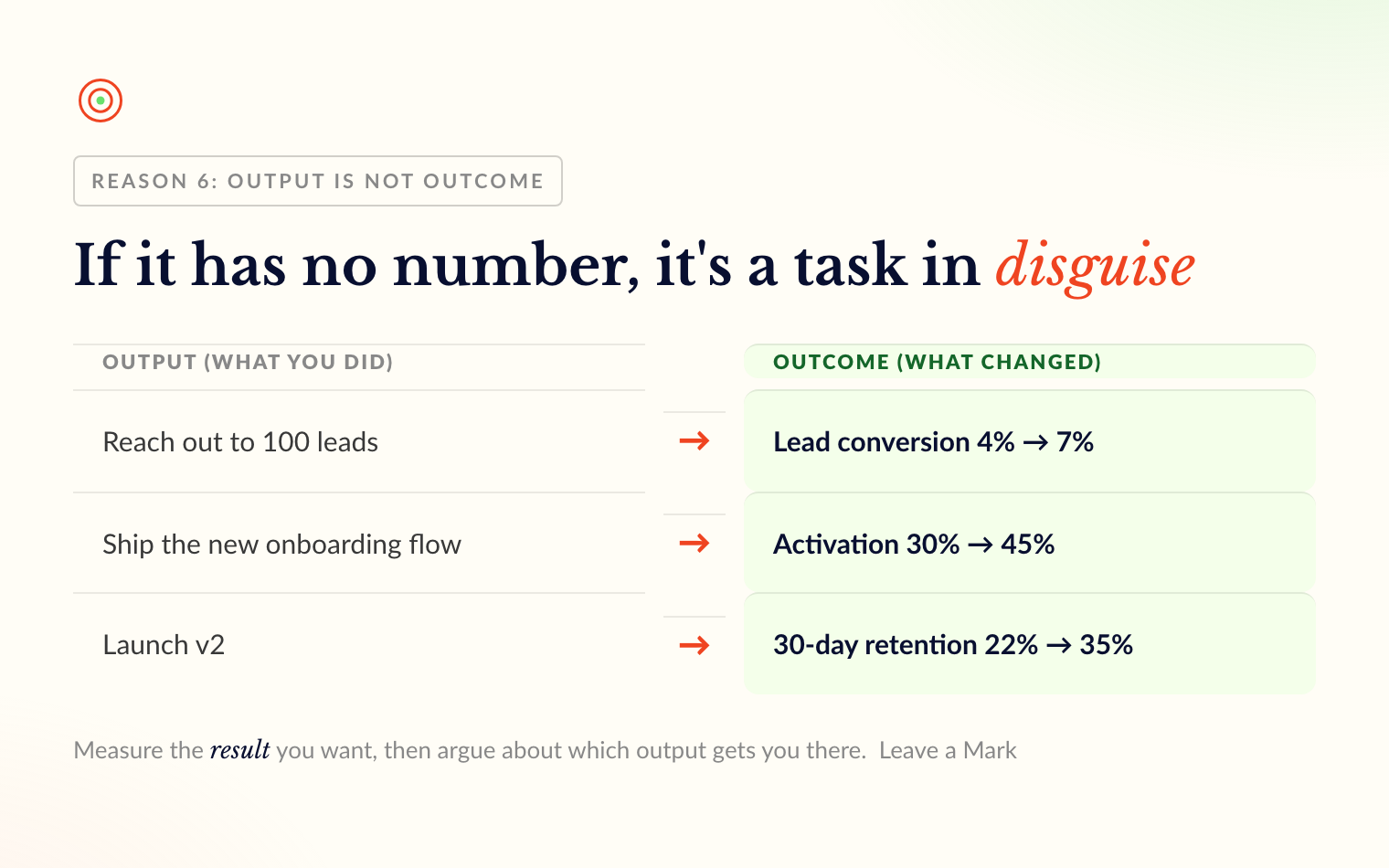
This is the most common death of all. Shipping a thing is effort. The outcome is what changes because you shipped it. "Reach out to 100 leads" is output; "increase lead conversion from 4% to 7%" is outcome. "Launch v2" is output; "grow 30-day retention from 22% to 35%" is outcome. If a key result has no number, it isn't a key result, it's a task in disguise. Measure the result you want, then let the team argue about which output gets them there.
7. Nobody agreed how the numbers are calculated
A case we saw: Two teams report on "active users". In the check-in it turns out one counts anyone who logged in, the other counts anyone who took an action. The number on the dashboard is meaningless and the meeting derails into a definitions fight.
The moment a key result has a metric, someone has to own how that metric is calculated, and everyone has to agree before the cycle starts. Otherwise your check-ins become debates about the ruler instead of the progress. Agree the definition, agree the source, agree who owns the calculation. Clarity of numbers is boring, unglamorous, and the difference between a check-in that solves problems and one that argues about them.
8. Everything everywhere, and none of it in one place
A case we saw: A company has the numbers. They live in someone's Looker, someone else's spreadsheet, a Slack thread, and the CFO's head. Every check-in starts with twenty minutes of "does anyone have the latest figure?" and the real conversation never happens.
You don't need an expensive dashboard. You need to know where the numbers live and to have them ready before the meeting, not during it. The failure isn't a lack of tooling. It's that the data is scattered, so nobody arrives prepared and the ritual collapses under its own admin. Decide where each number lives, update it before the check-in, and protect the meeting for thinking, not fetching.
9. You confuse business-as-usual with change
A case we saw: A support team makes "maintain CSAT above 90%" their headline OKR. They already run at 91%. A whole quarter of "objective setting" produced a goal to keep doing exactly what they were doing.
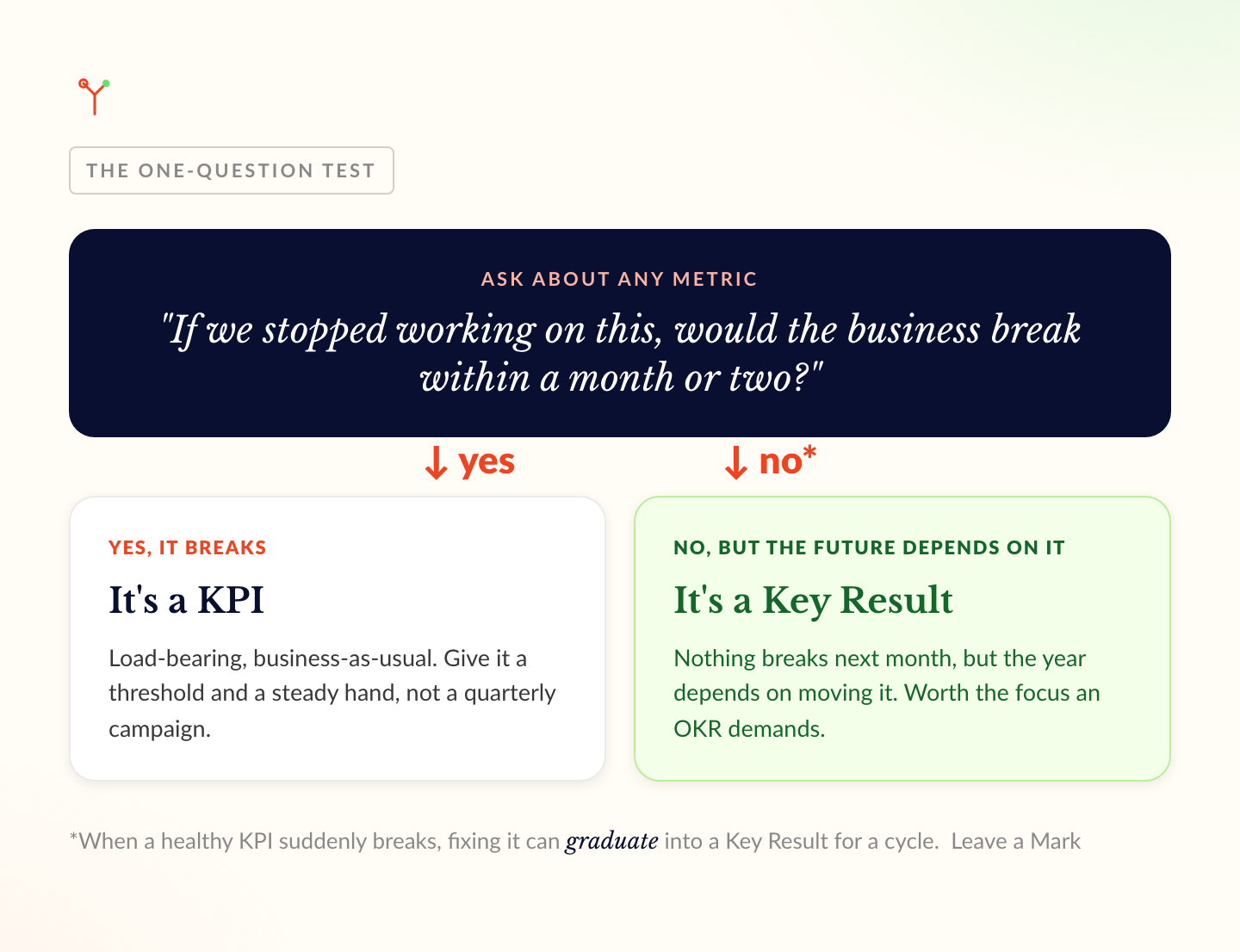
Some of your work keeps the lights on. Some of it changes the company. Those are different jobs and they need different instruments. Keeping the machine running is a KPI, roughly 70% of the energy, and it's measured against a target you already know how to hit. OKRs are for the other 30%: the change you're trying to make that isn't guaranteed and might fail. If a key result is something you already do well and just want to sustain, it's a KPI wearing an OKR costume. (We give this its own article next, because it's the mix-up that quietly kills the most implementations.)
10. You have no rituals, and no time for them
A case we saw: A founder loves the idea of OKRs and hates meetings. So the company sets goals in January and looks at them again in April. In between, nothing. The OKRs didn't fail. They were never actually run.
OKRs cost time, and pretending otherwise is how they die. Setting a cycle takes maybe 4 to 8 hours. Then a weekly check-in of 30 to 60 minutes, a summary, a retro. Call it 1 to 2 hours a week across the quarter. That's the real price. If you can't commit to the rhythm, don't start, because OKRs without a cadence are just a document you wrote once and abandoned. The rituals are not overhead around the system. They are the system.
11. You turn the check-in into theatre
A case we saw: Every Monday, each lead reads out what they did last week. Everyone nods. It takes forty minutes and changes nothing. It looks exactly like accountability and functions as its opposite.
The check-in is not a status report. Status is what you enter before the meeting so the meeting doesn't waste time on it. The check-in itself is for the hard part: where is a key result at risk, what's the biggest obstacle, who does what about it this week. If people leave the room with the same problems they walked in with, you held a performance, not a working session. This is the move from accountability that sits with the board to ownership distributed across the team, and it only happens if the meeting is about solving, not reporting.
The pattern under all eleven
Read them again and the common thread is obvious. Almost none of these are failures of the OKR format. They're failures of the ground OKRs stand on: no direction, no strategy, no buy-in, no focus, no rhythm, no honesty about numbers.
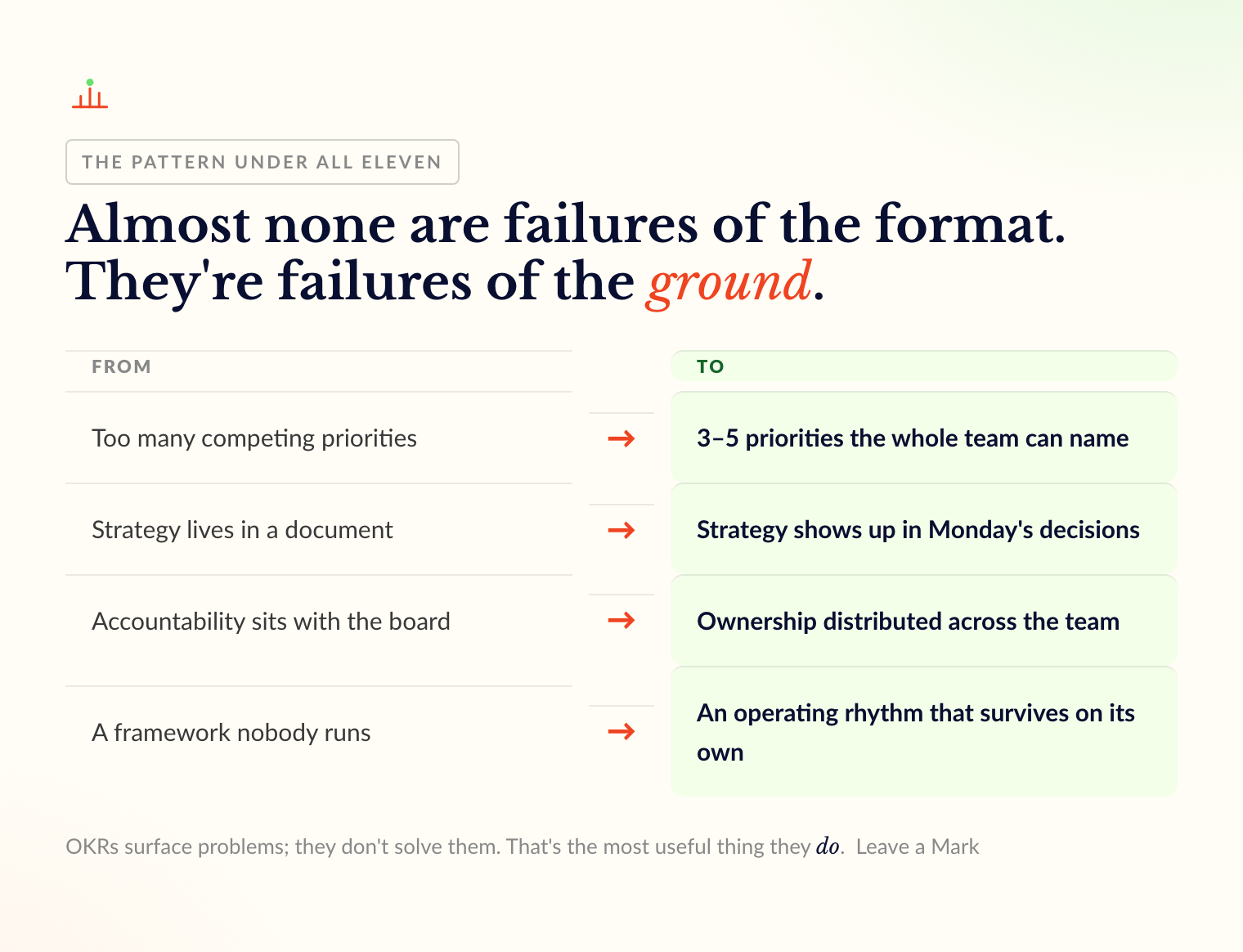
OKRs surface problems; they don't solve them. They will show you exactly where your foundations are thin, your strategy is vague, or your leadership is hedging. That's not a bug. That's the most useful thing they do, if you're willing to look.
What to do next
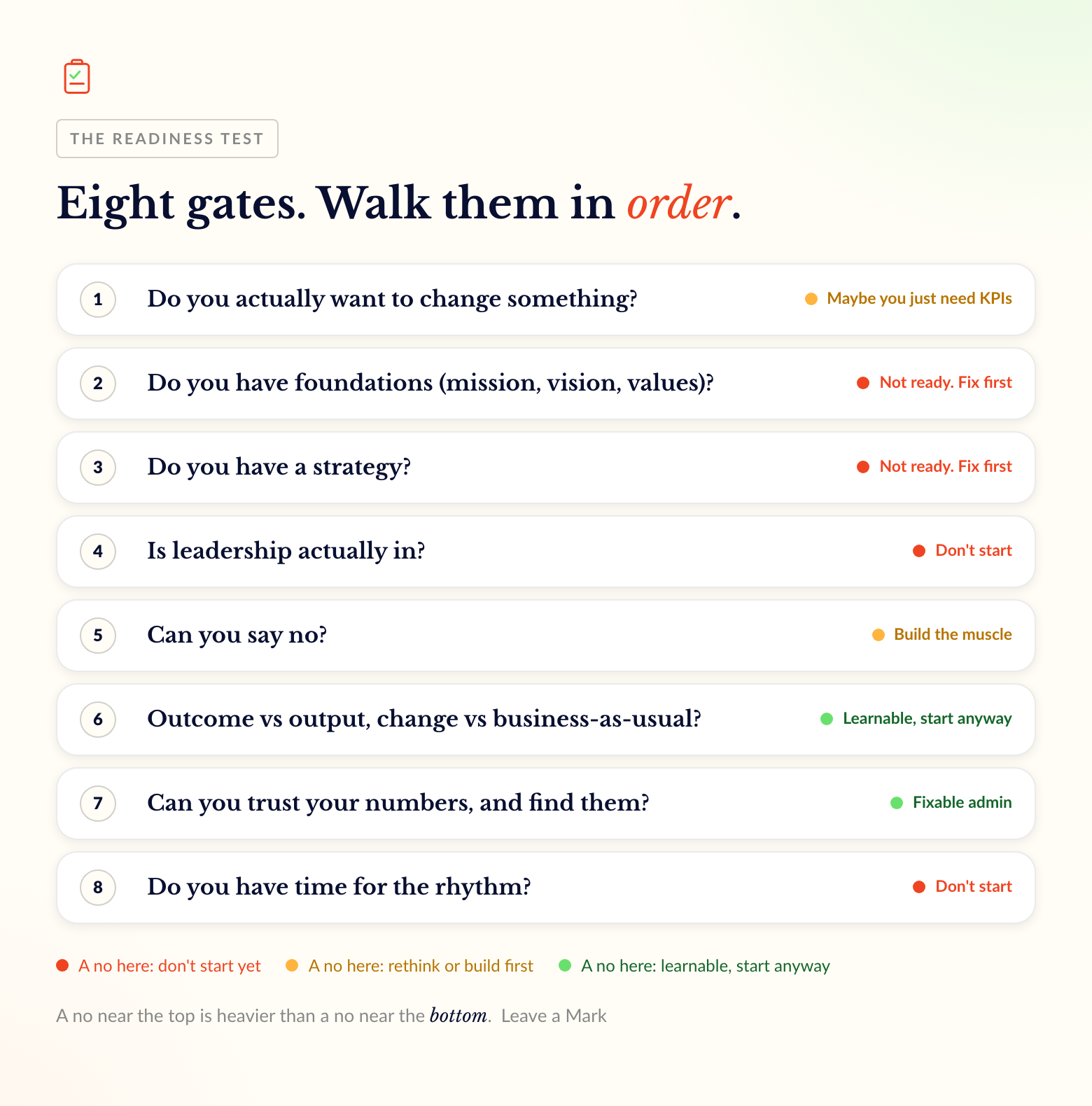
You don't need to fix all eleven at once. You need to know which ones are yours. That's the entire point of the next two articles: first the difference between OKRs and KPIs (reason 9, given its own treatment), then a readiness test that tells you, honestly, whether you should start at all.
If you already recognise your company in three or four of these headstones, that's not a reason to avoid OKRs. It's a map of the work to do first, so that when you set them, they turn into behavior instead of a fourth abandoned framework.
Leave a Mark helps leadership teams turn strategic chaos into clarity and execution, working side by side until clear strategy, focused priorities, and a new operating rhythm hold on their own. Strategy that becomes behavior.