The doors close, the last guest leaves, and every part of you wants to go home. You have been on for hours, maybe days. The room worked, or it mostly worked, and the relief is enormous. This is the moment almost everyone treats as the finish line.
It isn't. Here is the thing I have come to believe after a few dozen flagship events and hundreds of smaller ones: hosting the event does not finish when the event starts. It finishes about a week after. Two things have to happen before you have really closed it, and the sooner you start the better. You have to debrief honestly while the event is still fresh, and you have to turn what you learn into the plan for the next one. Asking for feedback and planning the next event are not admin you get to later. Debrief and Evaluation are what closes and experience.
One of the best tools I discovered for a team debrief is called and After Action Review. It works way better than a vague "how did that go?" over coffee. I got to learn it while reading a book called Culture Code by Daniel Coyle. (righly recommend the read!)
The debrief is the close, not the paperwork
Priya Parker, in The Art of Gathering, argues that a gathering needs a real ending, one you design on purpose rather than let dribble away. Most hosts think the ending is the closing remarks. It isn't. For me the real ending is the debrief, and it happens after everyone has gone home.
The After Action Review comes from the U.S. Army, codified in 1993 in a leader's guide called TC 25-20. Soldiers ran mock battles in the desert, and after every one they sat down and told each other the unvarnished truth about what just happened, so the next engagement would go better. Business borrowed it. Marilyn Darling and her colleagues studied the Army's best practitioners and wrote it up for Harvard Business Review in 2005, in a piece called "Learning in the Thick of It." Their finding is the one that matters most for hosts, and I will come back to it.
The method itself is simple. It is just a handful of questions:
The five questions
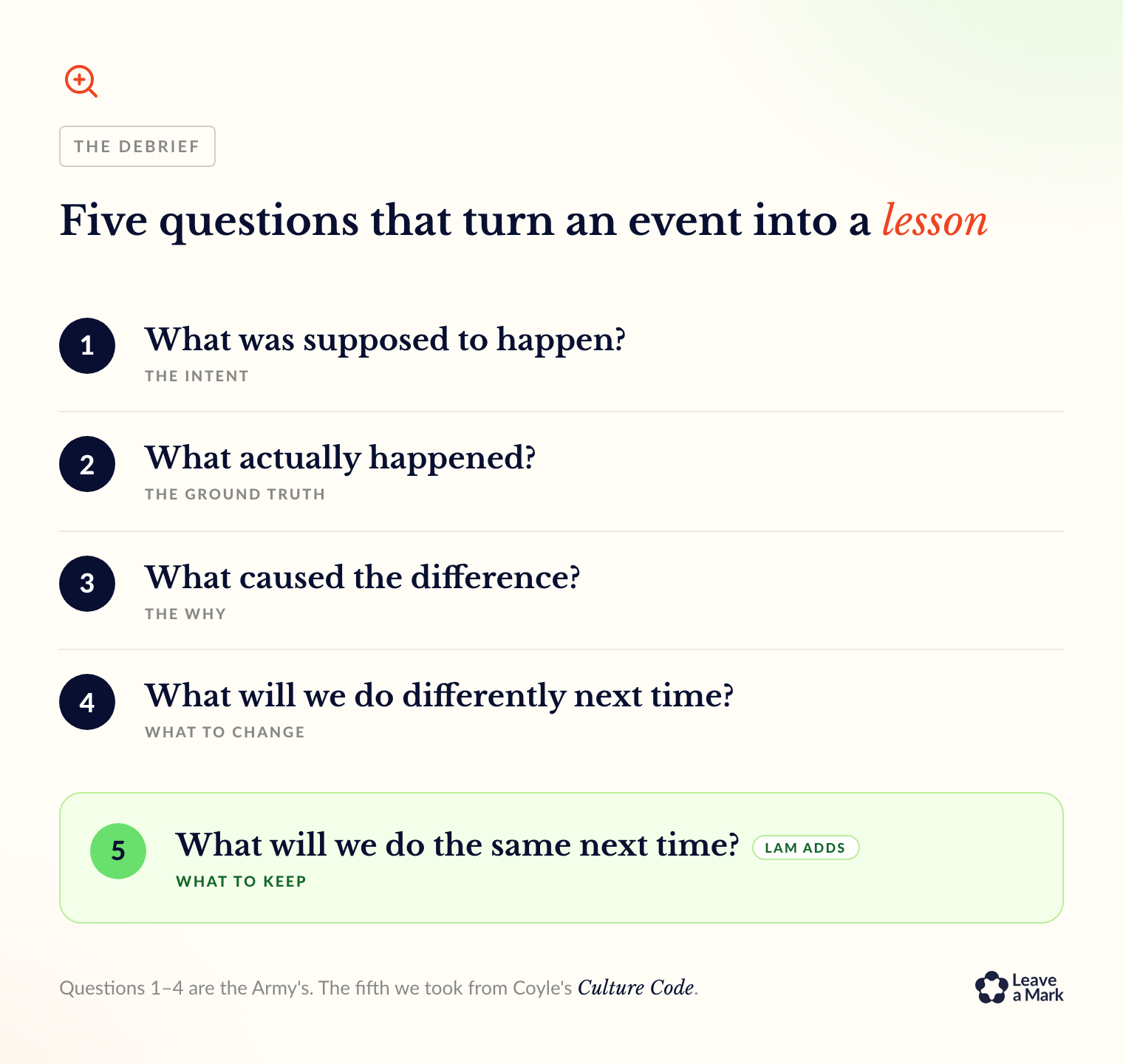
The Army's version is four:
- What was supposed to happen? What was the purpose, and what did you plan? You cannot judge an event against nothing. Start with the intent.
- What actually happened? The Army's people call this "ground truth." Not the polite version, not the version you will tell the sponsor. What really happened in the room.
- What caused the difference? Where the plan and reality parted ways, why? This is the honest, uncomfortable question.
- What will we do differently next time? The one everyone remembers to ask.
At Leave a Mark we run a fifth, which we were missing for our work.
- What will we do the same next time?
For me it felt that a debrief left to its own gravity turns into a list of faults, and you quietly stop doing the things that actually worked, because nobody said them out loud. Naming what to keep protects the fragile, good parts of an event that are the easiest to lose in the next edition. You learn as much from what to repeat as from what to fix.
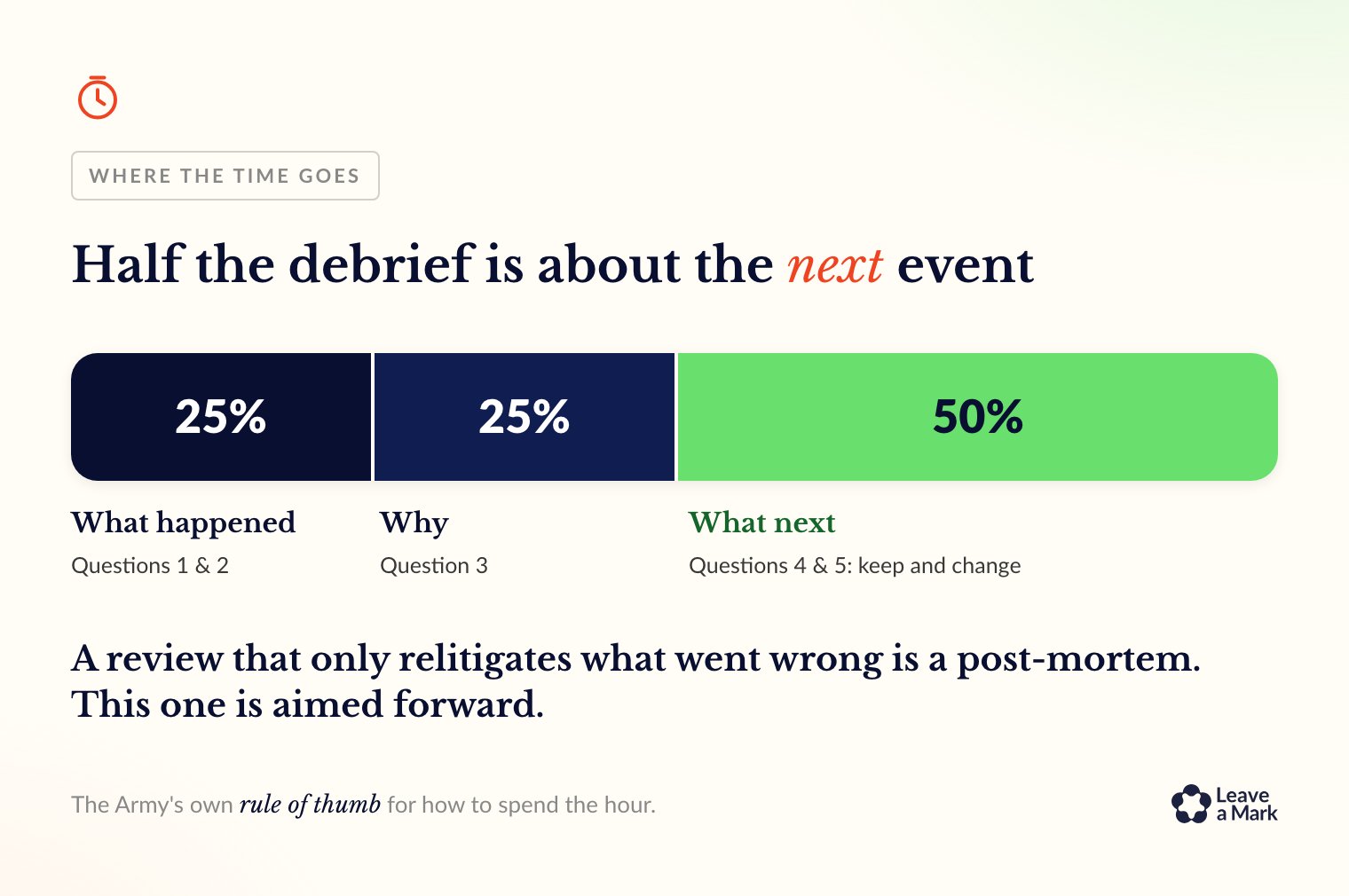
The Army has a rule of thumb for the time: roughly a quarter on the first two questions, a quarter on the third, and fully half on the two forward-looking ones. Read that again. Half the debrief is about the next event, not this one. A review that only relitigates what went wrong is a post-mortem. This is aimed forward.
Do it while it is still warm
Do not schedule the debrief for next Tuesday. Do it while the event is still in your body.
Coyle describes how the Navy SEALs finish a mission. They come back in, put down their weapons, grab water and something to eat, and then they sit and talk, right there, while it is all still fresh. Not a form filed the following week. A conversation held minutes after, with rank switched off and, in his phrase, a backbone of humility switched on. The immediacy is the point. Wait three days and memory has already sanded off the specifics and started telling you a kinder story.
At Leave a Mark we run ours on the train. We finish a workshop, pack up, get on the train home, and before anyone opens a laptop we go through the questions together while the room is still fresh in our heads. By the time we reach our station we know what we will keep and what we will change for the next one. The ride that would have been dead time becomes the most valuable hour of the whole engagement.
A few things make the conversation work, whether it happens on a train or around a table:
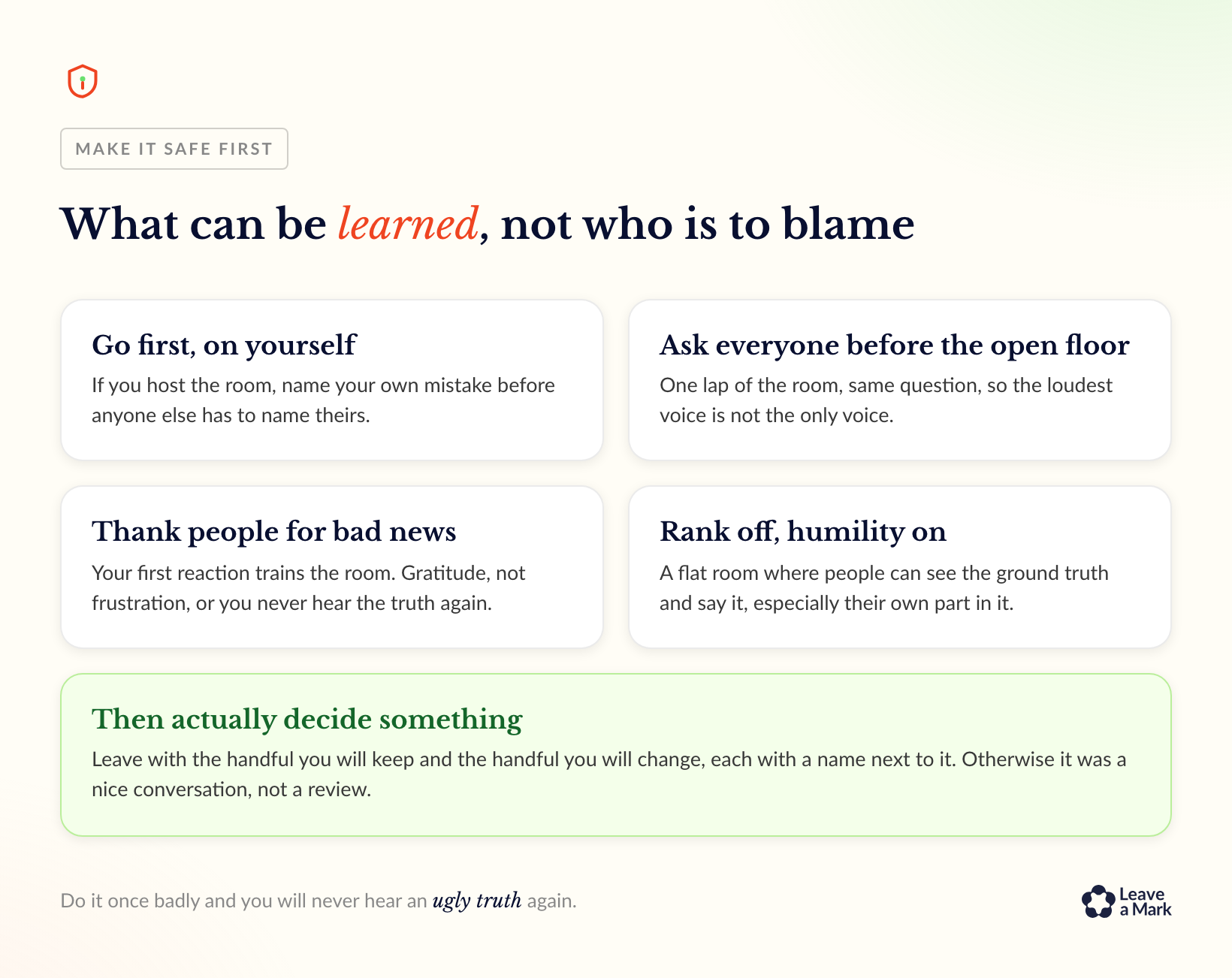
Name the one rule out loud: what can be learned, not who can be blamed. The moment a debrief turns into a search for whose fault it was, people go quiet and the ground truth dies with them. You want the person who dropped the ball to say so freely, because that is where the lesson lives.
Go first, and go first on yourself. If you host the room, you set the temperature. Open by naming your own mistake before anyone else has to name theirs. It gives everyone permission and it costs you nothing you can't afford.
Ask everyone before you open the floor. Go around the room once, each person on the same question, before the discussion opens up. Otherwise the loudest voice becomes the only voice, and the quiet person who saw the real problem never says it.
Thank people for the bad news. When someone brings you an ugly truth, your first reaction trains the whole room. Gratitude, not frustration. Do it once badly and you will never hear an ugly truth again.
Then actually decide something. Capture the handful of things you will keep and the handful you will change, each with a name next to it. A debrief that ends without a written, owned decision was a nice conversation, not a review.
Here’s our template
After Action Review - Template: (1)
Running it alone
You will often debrief by yourself. A small event, a solo host, no team to gather. The five questions still work, but running them alone has one trap: you are the easiest person in the world to lie to.
I will give you a real one. I once forgot I had invited a speaker. He turned up on the day, and I had to reshuffle the agenda on the spot while pretending this was all according to plan. The comfortable story is "the schedule was tight." The ground truth is that my organization was poor and I nearly wasted a guest's afternoon. Only the second version teaches you anything. Owning it, rather than reaching for the version that protects me, is the entire discipline of a solo review.
Because your memory will flatter you, lean on things that can't: the run sheet, the timeline, the photos, the feedback scores, the actual money. Objective evidence is what keeps a solo debrief honest. Sit with the five questions and something real in front of you, and write your answers down, both the things to keep and the things to change. The writing is not decoration. It is what stops you from concluding "that went fine" and moving on.
Why most debriefs fail
Here is the finding from that HBR study, and it is the one worth keeping. Most organizations fail at this not because they ask bad questions, but because they treat the review as a report. A thing you write at the end, file, and never open again. It's actually one of the things we also struggled with at Leave a Mark, treating a review as a report. It puts this burden on top of the people involved, but when treating it light yet diligent is where the magic happens.
The best practitioners treat it as a loop. The lesson from this event becomes the plan for the next one. The debrief of one gathering is the opening brief of the next. This is why hosting a single great event is easy and hosting a series is hard. The series is the loop. Never forget to ask for feedback, and never forget to plan the next one. Do both, in the week after the doors close, and you are not just recovering from one event. You are compounding.
From the room to the boardroom
None of this stays on the event field. The most expensive gathering most teams run is not a conference. It is the quarter. A leadership team ships a strategy, works it for three months, and then rolls straight into the next quarter without ever asking the five questions about the last one. No ground truth, no lesson, no loop. The same OKRs miss for the same reasons, and nobody says so out loud.
An offsite deserves a debrief. A quarter deserves a debrief. A launch deserves a debrief. And it deserves the same blameless, forward-facing, someone-goes-first discipline you would give a room full of guests. This is a large part of what a facilitator actually does in a leadership room: hold the process so a team can tell itself the ground truth without it turning personal. We do it for teams because most teams cannot do it for themselves. The founder who ran the event is rarely the one who can sit in it and hear the honest version.
Hosting ends a week later. So does leading. The close is where the next one begins.
The Host's Question
For your next gathering: before you leave the venue or step off the train home, will you have asked what really happened, and written down what you will keep and what you will change?
For your next leadership meeting: when did your team last debrief a quarter the way a good host debriefs an event, telling itself the ground truth without it becoming about who to blame?