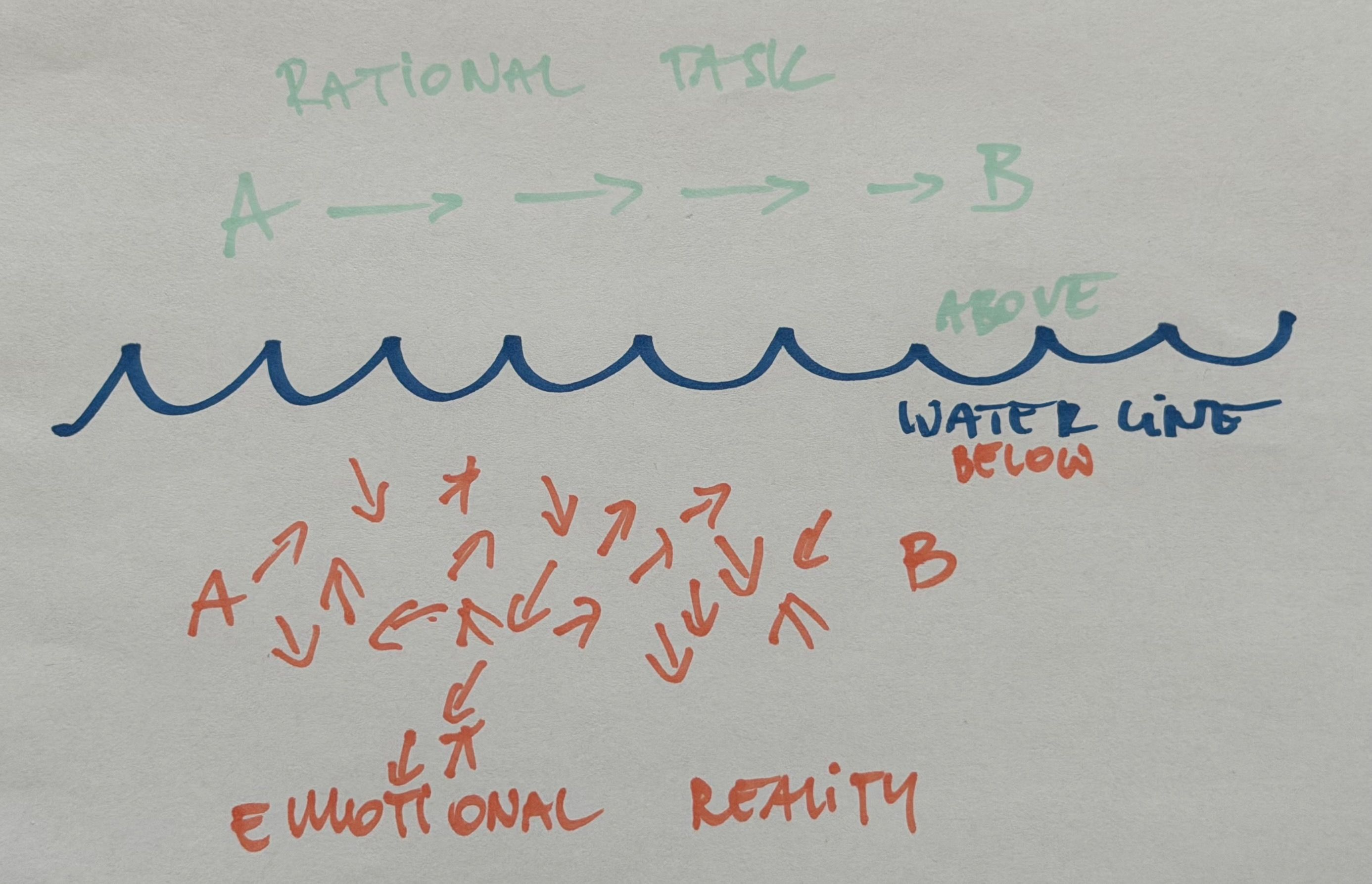
Every meeting happens on two levels simultaneously. It doesn’t matter if it’s a team meeting, management meeting or people coming together for dinner. It just happens on two levels.
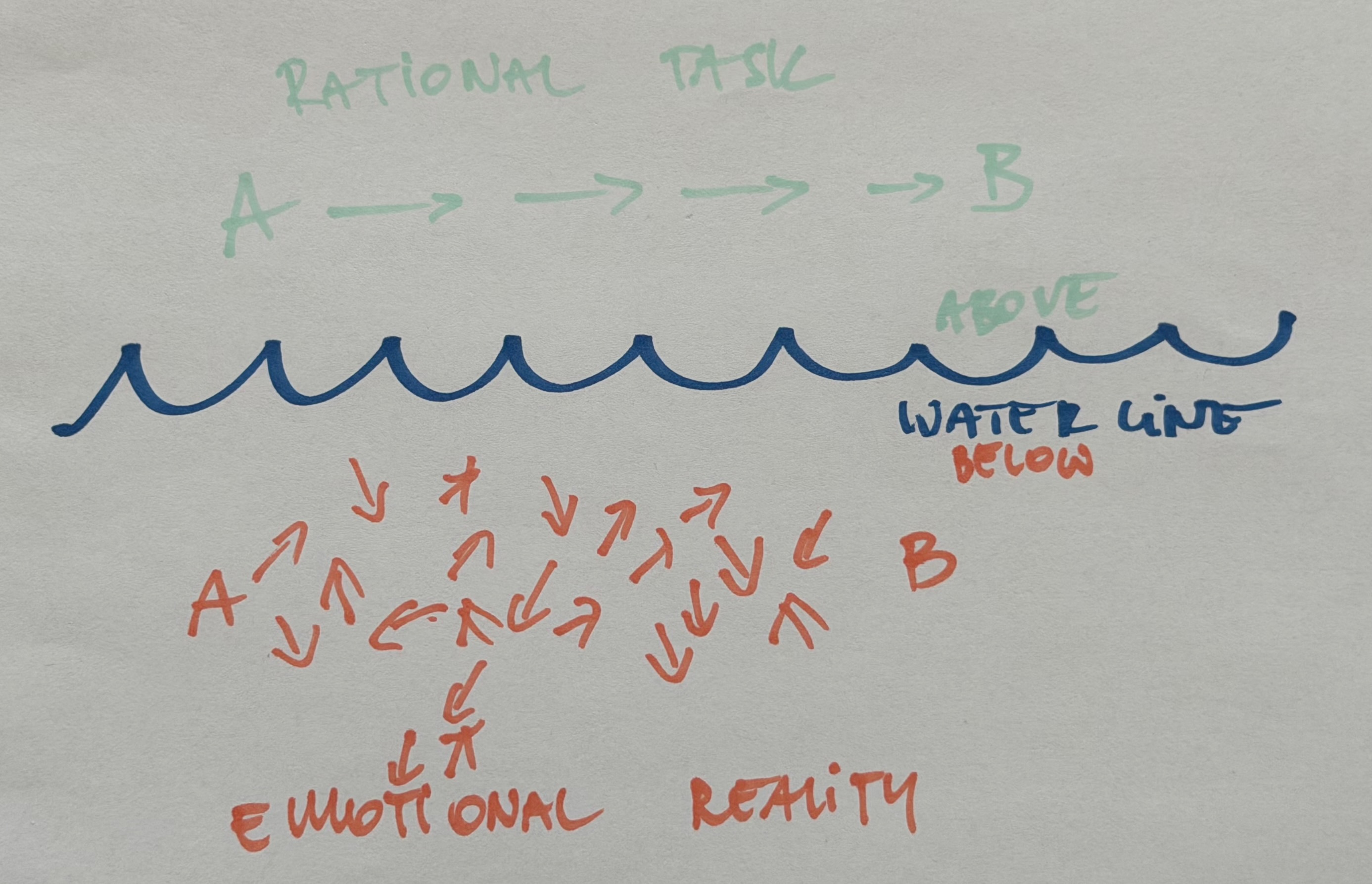
Above the waterline. It’s what the conversation is about. You may be discussing quarterly OKRs, resource allocation, and strategic priorities. The conversation sounds rational, professional, task-focused. It's what you think you hired these people for.
Below the waterline. Something entirely different is happening. Emotional exachange. Anxiety about change. Territorial defense dressed up as strategic thinking. Unspoken resentment about past decisions. The real conversation everyone knows matters but nobody wants to start.
What I've learned working with teams across industries: what's above the waterline rarely matters as much as what's below it.
You can have the clearest strategy and plans in the world, but if your team is fighting invisible battles underneath, that strategy will drown.
The model of waterline was first shown to me by John Scherer.
The Iceberg Your Strategy Keeps Hitting
Most people I work with are incredibly sophisticated about what's above the waterline. They've read “the books”. They know about trade-offs and focus. They can articulate their goals, know the processes.
But their teams still can't execute. Meetings devolve into the same unproductive patterns. Cross-functional collaboration feels like trench warfare. Simple decisions take weeks of political maneuvering. Things do not happen…
The problem isn't the strategy. The problem is that above-the-waterline solutions don't fix below-the-waterline problems.
Think about the last time your meeting got stuck on a decision. On the surface, it probably looked like a rational disagreement about resources, timelines, or priorities. But underneath, something else was happening. Someone protecting their territory. Someone afraid of looking incompetent. Someone still angry about a decision from six months ago that was never properly discussed.
This is the waterline doing its work. What you see above the surface is almost never the actual problem.
Patterns That Live Below the Waterline
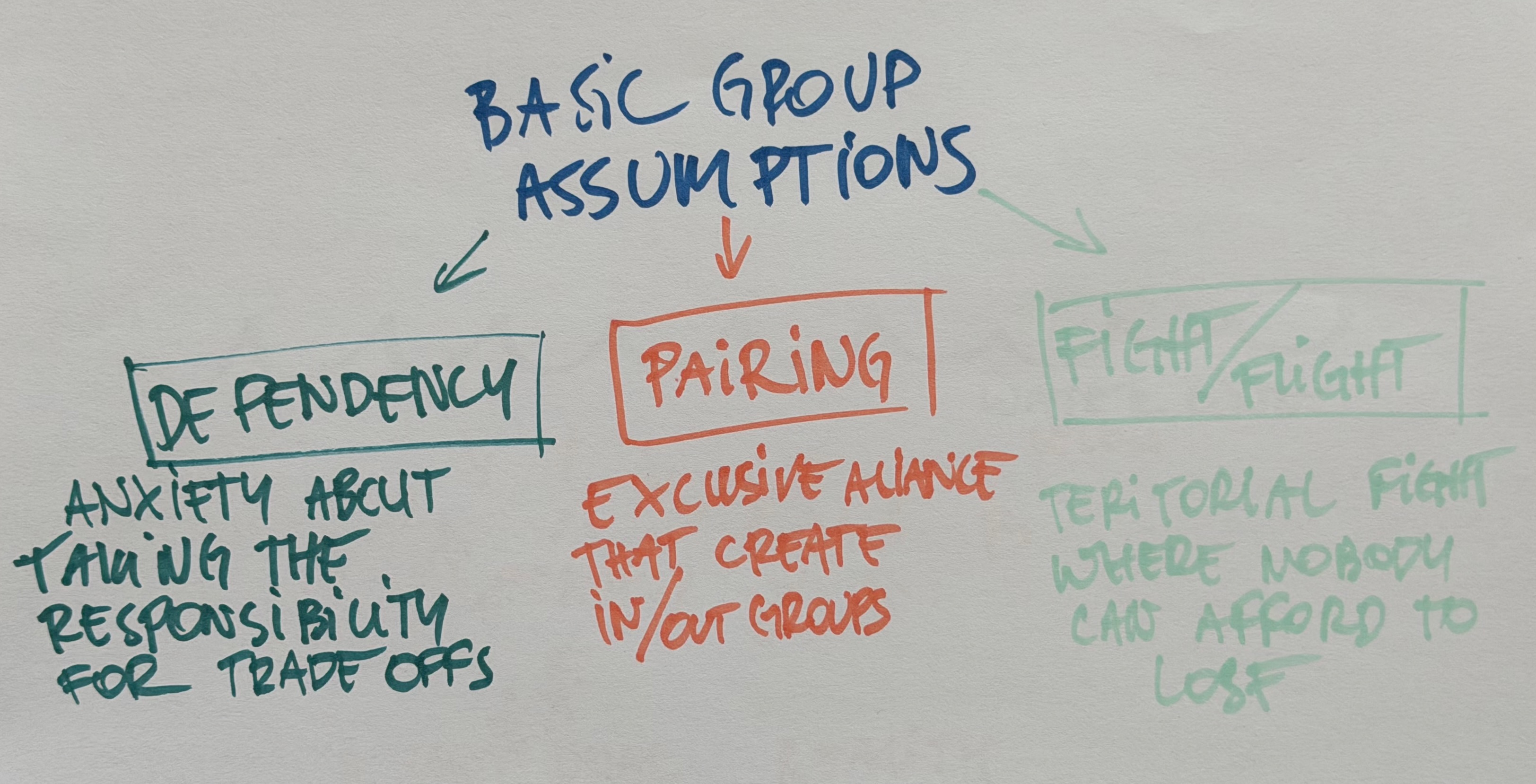
One of the father of group dynamics is Wilfred Bion. He run a Nothfield experiment when working with post II WW soldiers. I his work he noticed Basic Group Assumptions.
Those patters repeat in all groups all the time. They're predictable, they're unconscious, and they're incredibly destructive if left unnamed.
The first pattern is dependency. The team acts as if their only job is to wait for the CEO to provide all the answers. Every discussion ends with "What do you think we should do?" Nobody takes ownership because they're all waiting for the leader to be certain first. This looks like deference above the waterline. Below the waterline, it's anxiety about taking responsibility for difficult trade-offs.
The second pattern is pairing. Two people form a special relationship that everyone else resents. Maybe it's the CEO and CFO who seem to make all the real decisions in private. Maybe it's the CTO and Head of Product who've formed an alliance that blocks everyone else. Above the waterline, it looks like partnership. Below the waterline, it creates an in-group and out-group that poisons collaboration.
The third pattern is fight-flight. Every decision becomes a battle. People either attack each other's proposals or avoid conflict entirely by staying vague and uncommitted. Above the waterline, it looks like healthy debate or professional disagreement. Below the waterline, it's territorial warfare where nobody can afford to lose.
These patterns aren't personality problems. They're predictable group responses to anxiety. When teams face uncertainty, complexity, or change, they default to these defensive postures. The work above the waterline grinds to a halt while everyone manages their anxiety below it.
Why Smart People Keep Making the Same Mistakes
Here's what makes this challenging: the people exhibiting these patterns are often your most talented leaders. They're smart, experienced, and genuinely committed to the company's success. They're not trying to sabotage anything. I’ve been in those patterns many times myself.
When anxiety rises, rational thinking goes offline. The brain's threat-detection systems take over. People revert to patterns that helped them survive in previous environments, even when those patterns are counterproductive here.
The CFO who's excellent at dependency-creating behavior probably learned that being the person with all the answers made them indispensable in their last role. The two executives who form an exclusive pairing probably found that alliance-building was the only way to get things done in a previous dysfunctional organization. The leader who turns every discussion into a fight probably came from a culture where nice people finished last.
None of this is conscious. Nobody wakes up thinking "Today I'm going to create a toxic dynamic in my leadership team." But the pattern persists because nobody names it.
And here's the trap: the more you try to fix these problems with above-the-waterline solutions, the worse they get. You create a new framework for decision-making, but people use it to avoid the real conversation. You mandate better cross-functional collaboration, but the mandate itself becomes another battle to fight. You bring in a new strategic planning process, but the team uses planning sessions to act out the same unresolved conflicts.
What Actually Changes Things
The only thing that breaks these patterns is making the invisible visible. Naming what's below the waterline so the team can actually address it.
This doesn't mean turning every business meeting into therapy. It means creating enough safety for people to acknowledge the real dynamics at play. It means a leader being willing to say "I notice we keep having this same argument with different spreadsheets. What are we really fighting about?"
It means distinguishing between the work of the team and the emotional experience of being in the team. Both are real. Both matter. But you can't address the emotional reality with task-focused solutions.
Teams transform when someone finally names what everyone already knows but nobody's been willing to say. The head of sales who admits "I feel like I have to fight for resources every quarter because I don't trust that this team values what we do." The CTO who acknowledges "I've been waiting for you to tell me what to build because I'm afraid of making the wrong bet." The CEO who says "I think I've created a culture where you all wait for me to decide because I micromanaged the early days."
These moments of honesty create the conditions for actual change. Not because vulnerability is inherently valuable, but because you can't solve a problem you won't acknowledge.
How We Work Both Levels at Leave a Mark
This is why at Leave a Mark we work both above and below the waterline simultaneously. Because you need both. We address the work to be done and what happens to humans doing the work.
Above the waterline, we help leadership teams build the structures that enable execution. Clear strategy means making explicit choices about where to play and how to win. It means identifying the things you will not pursue so resources don't get diluted across twelve priorities. It means creating lightweight accountability systems like OKRs that keep the team aligned without drowning in process.
But that's only half the work.
Below the waterline, we help teams see the patterns that sabotage their best intentions. We create space for the conversations they've been avoiding. We name the anxiety that's driving defensive behavior. We help leaders distinguish between legitimate strategic disagreements and emotional reactions to perceived threats.
Most consultants pick a side. Strategy consultants pretend everything can be solved with better frameworks and clearer thinking. We’ve been there ourselves many times. Culture consultants pretend everything can be solved with more vulnerability and psychological safety. We also have been there. On both sides we were wrong.
The real work happens when you address both levels at once. When you help a team make explicit strategic trade-offs while also acknowledging the fear and uncertainty those trade-offs create. When you build clear decision rights while also addressing why certain leaders don't trust the process. When you create accountability mechanisms while also examining why accountability feels threatening to this particular group.
This is harder work than just delivering a strategy deck or running a team-building workshop. It requires staying in the discomfort long enough for something real to shift. It means being willing to point out the patterns the team would prefer to ignore. It means holding the tension between what the team says it wants and what its behavior reveals it's actually optimizing for.
The Conversation You're Avoiding
If you're a leader reading this, here's my question: what's happening below the waterline in your team right now?
You probably already know. There's probably a conversation you've been avoiding. A dynamic you've noticed but haven't addressed. A pattern that repeats but you've convinced yourself will resolve on its own.
It won't.
What's below the waterline doesn't improve with time. It doesn't get solved by better strategy documents or new OKR frameworks. It gets solved when someone with authority is willing to name it and create space for the team to work through it together.
The work above the waterline is easier. It's cleaner. It feels more professional. But it's insufficient.
The real leverage is below the waterline. That's where the actual problems live. That's where alignment either happens or doesn't. That's where your strategy either comes alive or drowns in unspoken conflict.
Most leadership teams spend ninety percent of their time talking about what's above the waterline while what's below the waterline controls the outcomes. The teams that actually execute well do the opposite. They spend enough time below the waterline that what's above it can finally work.
Your strategy is probably fine. Your team's ability to have honest conversations about what's really happening is probably not.
What conversation is your team having below the waterline?
Basic Group Assumptions by Wilfred Bion. Experienced everyday in the field by Leave a Mark.
The Waterline Model: Based On Work by R. Harrison, J. Scherer and R. Short