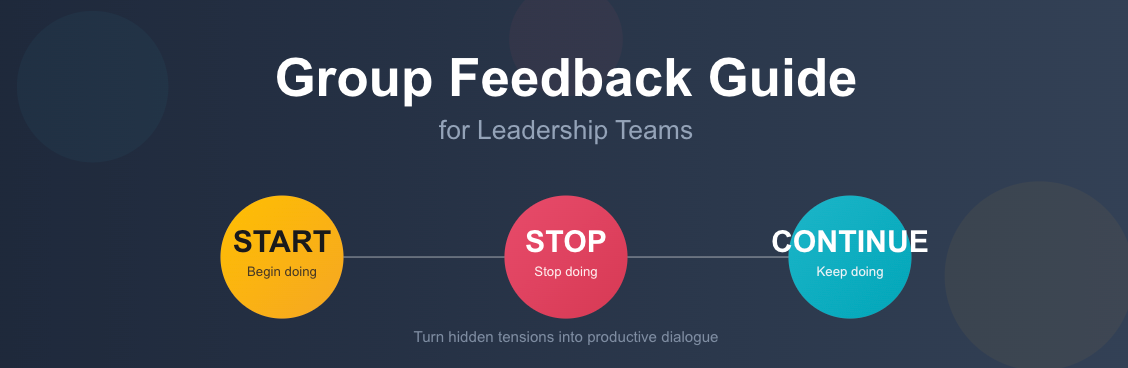
Group Feedback Guide for Leadership Teams
The Problem
Leadership teams avoid the conversations that matter most.
Concerns travel in side channels. Feedback is given one-on-one or not at all. The group rarely talks directly about how it works together.
Meanwhile, decisions slow down. The same priorities get relitigated. Each function optimizes its own area while the team fails to act as one unit.
This tool provides a structured way to surface what is usually left unsaid. It turns hidden tensions into productive dialogue and concrete improvements in how the team operates.
When to Use This Tool
Use group feedback as a regular practice, not crisis management:
Regular team development
- Quarterly or bi-annual sessions to maintain healthy dynamics
- After significant projects to reflect on collaboration patterns
- During transitions when members join or roles change
When specific patterns emerge
- Tension you feel but don't name
- Side conversations and withdrawal appear, but hard topics never surface in meetings
- Decisions are slow or confusing
- The same decisions get revisited without clear ownership
- Low synergy between functions - silos dominate
To model the culture you want
- The leadership team demonstrates the behaviors it expects from the organization
Critical principle: Don't wait for a crisis. This works best as regular practice (quarterly) to keep the system healthy and prevent issues from accumulating.
How to Use - Complete Guide
Ground Rules (Establish First)
Before beginning, agree explicitly on ground rules:
- Speak to each other, not about each other
- Describe behaviors and situations, not personalities or intentions
- Talk about impact on the team and organization, not only personal preferences
- Listen fully - no interrupting, defending, or explaining during feedback rounds
- Everything shared is confidential with no retaliation
- Use specific examples, not vague generalizations
- Connect every behavior to business impact (decisions, speed, alignment, results)
Facilitator role: Consider appointing someone (internal or external) to hold the structure, remind the group of rules, and keep conversations focused on behaviors and impact.
Step 0: Define Focus Areas
Choose 3-5 specific areas that matter most to your team's effectiveness.
Examples:
- Quality of discussions (depth, honesty, ability to disagree constructively)
- Decision-making (clarity, speed, follow-through)
- Mutual support and trust between leaders
- How decisions are communicated to the organization
- How conflict and difficult topics are handled
Write these where everyone can see them. This keeps feedback targeted and prevents it from becoming too general or personal.
Step 1: Preparation
For the person receiving feedback:
Communicate before the session:
- Purpose: Why you want feedback and what you hope to learn
- Focus areas: Which aspects of your leadership matter most right now
- Preferences: How you best receive feedback (tone, directness, what makes you feel safe)
For those giving feedback:
Prepare observations using this structure:
- Continue: What helps you collaborate with this person - behaviors, attitudes, and approaches you'd like them to maintain
- Start/Stop: What you'd like them to change - specific behaviors or patterns that could improve collaboration
Connect to business impact: Show how specific behaviors influence decision speed, team energy, risk management, organizational alignment, or strategic execution.
Use concrete examples tied to your focus areas, not vague generalizations.
Step 2: Feedback Session
Each team member takes turns receiving feedback. The session has two rounds.
Round 1: Continue (Positive Feedback)
Those giving feedback share one by one:
- Fact/behavior/attitude you've observed
- Feelings it evokes in you
- Impact on collaboration or the project ("Because of this...")
Person receiving feedback:
- Listens and takes notes
- Asks clarifying questions when needed
- Observes their own reactions (How easy is it to accept positive feedback? Do I believe it?)
- Thanks each person
- Does not defend or explain
Round 2: Start/Stop (Constructive Feedback)
Those giving feedback share one by one:
- Fact/behavior/attitude you've observed
- Feelings it evokes in you
- Impact on collaboration or the project ("As a result...")
- Need or suggestion for behavioral change
Person receiving feedback:
- Listens and takes notes
- Asks clarifying questions when needed
- Observes their own reactions (defensive reactions, desire to explain, anger, guilt)
- Does not express defensive reactions, does not defend themselves or explain
- Thanks each person
Step 3: Follow-up
Individual Reflection
Each person reviews their feedback notes and:
- Absorbs the positive feedback as a foundation to build upon
- Categorizes constructive feedback into:
- Yes, I agree and will implement
- Requires further conversation
- I won't implement this change at this time
Public Commitments
Each person shares with the team:
- What they understood from positive feedback and how they'll build on it
- What specific actions they will take by when
- What they won't change and why
- What topics need further discussion, with whom, and by when
- What support they need from the team
- When they'd like a follow-up check-in
Schedule Follow-up
Before ending the session:
- Agree on a specific date for follow-up (typically 6-8 weeks later)
- Define clearly what you will review:
- Have we practiced the new behaviors?
- What has improved? What remains difficult?
- Do our commitments need adjustment?
Treat this as part of your regular operating rhythm, not a one-off workshop.
Lack of visible follow-through destroys trust and makes future sessions harder.
Do's and Don'ts
DO:
✓ Create psychological safety with clear ground rules before starting
✓ Use specific, observable examples rather than generalizations
✓ Focus on behaviors and impact, not intentions or character
✓ Balance positive and constructive feedback
✓ Give the receiver time to process without interruption
✓ Follow through on commitments made during the session
✓ Schedule regular follow-ups to check progress
✓ Connect every feedback point to business results
DON'T:
✗ Allow the receiver to defend themselves during the session
✗ Pile on with similar feedback - if someone made the point, simply acknowledge agreement
✗ Make it personal or attack character
✗ Bring up highly sensitive issues for the first time in this setting - address those privately first
✗ Rush the process - allow adequate time for each person
✗ Skip the positive feedback round - it's essential for balance and receptivity
✗ Forget to document commitments and follow up
✗ Use this as a one-off crisis intervention instead of regular practice
The Pattern That Works
Most leadership teams wait until tension becomes unbearable.
High-performing teams make this a regular practice.
The difference? One treats feedback as crisis management. The other treats it as how the team gets better together.
Alignment comes from rephrasing toward shared understanding, not repeating slides.
Ready to organize feedback session?
Untitled if you want to talk about the problem your organization is facing and how strategy can address it.