Everyone wants engaged teams. Almost nobody knows how to actually build them.
I first encountered psychological safety through Brené Brown's TED talk on vulnerability. Later, Patrick Lencioni positioned it as the foundation in "The Five Dysfunctions of a Team"—the base layer without which nothing else works. Amy Edmondson dedicated an entire book to it in "The Fearless Organization."
All these sources told me what psychological safety was. What I was missing was how to actually create it in practice. How to stop appealing to people to "be vulnerable" and start building conditions where vulnerability becomes safe.
Then I discovered uWilliam Kahn's 1990 research during my studies at the Tavistock Institute, and everything clicked.
Kahn's Discovery: Three Conditions for Engagement
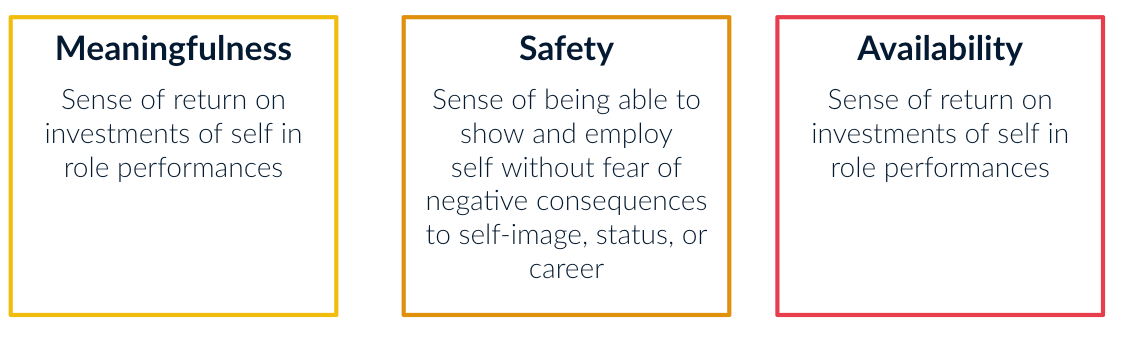
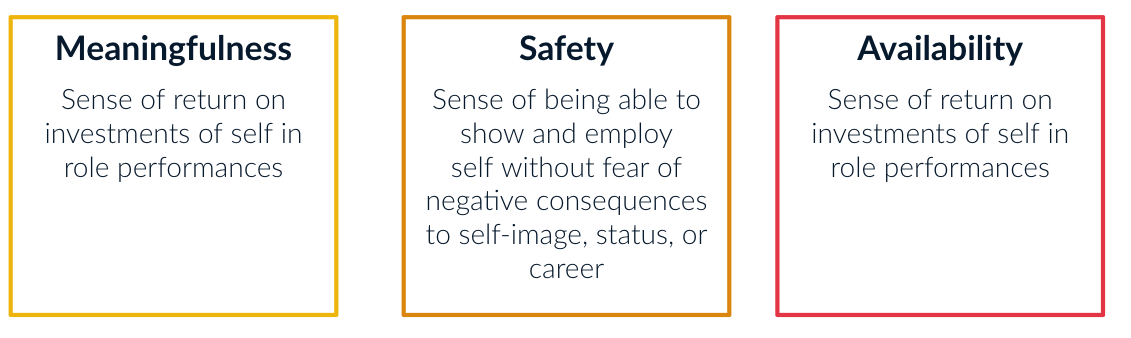
Kahn identified three psychological conditions that determine whether people fully engage at work or withdraw and defend themselves: meaningfulness, safety, and availability.
This wasn't about motivation. It was about the conditions people experience moment-to-moment that shape whether they bring their full selves to their work or hold back.
Let me break down each condition and what actually creates it.
Condition 1: Psychological Meaningfulness
Definition
The sense of receiving a return on investments of self in role performances. People feel worthwhile, valued, and valuable—as though they make a difference and are not taken for granted.
What It Feels Like
When work is meaningful, you feel able to give to others and to the work itself. You're not just going through motions. There's little room for you to contribute when meaningfulness is absent.
What Creates Meaningfulness
- Task Characteristics
Jobs that involve challenge, variety, creativity, autonomy, and clear goals create meaningfulness. People need tasks that demand both routine skills (creating competence) and new skills (creating growth).
When tasks are too simple or repetitive, people coast. When they're unclear or constantly changing, people can't find the through-line that makes their work matter.
- Role Characteristics
Your formal role carries an identity. Some identities fit how you see yourself; others don't. A counselor might love the teacher identity but hate the policeman identity. A designer might embrace being a collaborator but resist being a "hired gun."
Roles also carry status and influence. When you can shape outcomes, occupy a valued position, and see your impact on the world, you experience meaningfulness. When you're treated as unimportant or your work is seen as peripheral, meaningfulness evaporates.
- Work Interactions
Meaningful interactions promote dignity, self-appreciation, and a sense of worthwhileness. They blur the boundaries between personal and professional, allowing you to connect with others as full human beings, not just role occupants.
When clients or colleagues treat you as interchangeable or don't appreciate your efforts, those interactions drain meaning from the work.
Condition 2: Psychological Safety
Definition
The sense of being able to show and employ yourself without fear of negative consequences to self-image, status, or career. Situations feel trustworthy, secure, predictable, and clear in terms of behavioral consequences.
What It Feels Like
In safe situations, you can try and potentially fail without fearing consequences. You can speak up, challenge assumptions, and show who you really are. When safety is absent, you constantly monitor yourself, focus on external cues, and hide your real thoughts and feelings.
What Creates Safety
- Interpersonal Relationships
Relationships that are supportive, trusting, open, and flexible create safety. You can share ideas without feeling it's dangerous to do so. Any criticism feels constructive rather than destructive.
Unsafe relationships are characterized by disconnection. People put up walls. Crossing boundaries feels risky. In hierarchical relationships, power differences can make safety particularly fragile—superiors can change or end your role.
- Group and Intergroup Dynamics
Organizations have unconscious dynamics that cast people into informal roles. You might be "the reliable one," "the favorite," or "the problem child." These roles, shaped by group dynamics, determine how much room you have to safely express various parts of yourself.
The way organizational structures create "in-groups" and "out-groups" matters. Members of less powerful groups often get cast into unattractive, vulnerable roles, especially in interactions with more powerful groups.
- Management Style and Process
Supportive, resilient, consistent, trusting, and competent leadership heightens safety. Leaders who allow experimentation, maintain consistent reactions, and demonstrate control over their own responses create environments where people can take interpersonal risks.
Unpredictable, inconsistent, or hypocritical management destroys safety. When leaders say one thing Monday and change direction Friday, or when they go over people's heads arbitrarily, it becomes impossible to trust the constancy of your authority or assignments.
- Organizational Norms
Shared expectations about acceptable member behaviors create boundaries. When you stay within these boundaries, you feel safe. When norms are clear, you know what's allowed and what isn't.
Unclear or unspoken norms create anxiety. Deviating from expectations—even unknowingly—marks you as deviant. In open office spaces or small systems with no privacy, the constant exposure can make people guard themselves by withdrawing.
Condition 3: Psychological Availability
Definition
The sense of possessing the physical, emotional, and psychological resources necessary to invest yourself in role performances. You feel capable of driving physical, intellectual, and emotional energies into role performance.
What It Feels Like
When you're available, you have the resources to engage. When you're unavailable, you're depleted, distracted, or preoccupied—even if the work is meaningful and the situation is safe.
What Creates (or Destroys) Availability
- Physical Energy Personal engagement demands physical energy that disengagement doesn't. Physical exhaustion from sun exposure, long hours at a desk, or demanding schedules makes engagement impossible. You're simply worn out and unavailable.
- Emotional Energy Employing and expressing yourself in tasks requiring emotional labor takes emotional resources. Frustration from unsolved problems, constant demands for attention, or draining conflicts deplete these reserves. At some point, people have nothing left to give and withdraw.
- Insecurity
Three types of insecurity reduce availability:
Lack of self-confidence: You worry more about how your work will be received than about the work itself.
Heightened self-consciousness: You become an actor managing an audience rather than someone doing a job.
Ambivalence about fit: When work processes don't align with your values, you're already engaged in inner debates that leave little room for external engagement.
- Outside Life Events in people's non-work lives can either drain or charge availability. Relationship stress, family demands, or personal crises pull people away psychologically. Conversely, positive outside experiences can increase energy available for work.
The Critical Insight: These Are Conditions, Not Feelings
Here's what makes Kahn's framework powerful:
When people say they want to create psychological safety, they often think about vulnerability training or team-building exercises. But that's putting the cart before the horse.
The Vulnerability Mistake
Companies organize vulnerability workshops without changing the systems that punish vulnerability. That's a band-aid on a deep wound.
You cannot workshop your way to psychological safety. You have to design it into:
- How decisions get made (clear decision rights)
- How feedback gets delivered (consistent, supportive processes)
- How conflicts get resolved (explicit norms)
- How mistakes get handled (resilient management)
- How resources get allocated (transparent trade-offs)
Kahn discovered that group dynamics shape safety. The way organizational structure creates in-groups and out-groups, assigns informal roles, and distributes power determines who can safely show up fully.
Why This Matters for Execution
People won't flag problems if speaking up is risky. They won't challenge bad assumptions if dissent is punished. They won't collaborate across functions if organizational norms make that unsafe.
Without meaningfulness, people coast through work. Without safety, they hide their real thinking. Without availability, they simply don't have resources to engage.
Psychological safety isn't soft HR. It's the infrastructure that determines whether your organization can execute its strategy.
The Three Questions People Ask Unconsciously
In every work situation, Kahn found that people unconsciously ask themselves three questions:
The answers to these questions—shaped by task design, interpersonal relationships, group dynamics, management behavior, organizational norms, and individual circumstances—determine whether people engage or disengage in that moment.
From Theory to Practice
Understanding these three conditions transforms how you approach engagement:
Instead of asking "How do I motivate my team?"
Instead of running vulnerability workshops
Instead of appealing to people to care more
Instead of demanding more from exhausted people
Psychological safety, meaningfulness, and availability aren't programs you implement. They're conditions you build through consistent leadership behavior, structural design, and attention to the dynamics operating below the surface.
The Question That Matters
So here's the real question:
The answer reveals whether you're creating conditions for engagement or just talking about it.
References:
“Psychological Conditions of Personal Engagement and Disengagement at Work” - Kahn, William A in Academy of Management Journal; Dec 1990;